
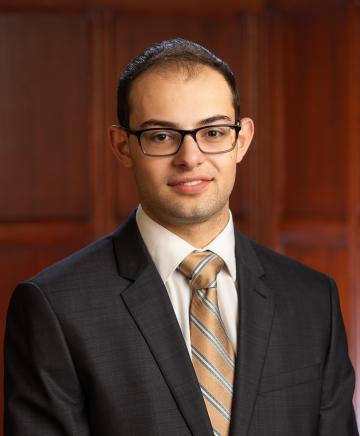
High School
Xaverian Brothers High SchoolUndergraduate Education
B.A. in Environmental Science and Economics from University of Notre Dame, 2026Profile
Forests have been places of wonder and sanctuary for Michael Parent ever since the summers he spent in Maine as a child. He has studied abroad and traveled through different habitats and environmental systems, but the trees and seasonal changes of northern temperate forests always draw him back.
Michael’s interest in the natural world manifested early. “I loved to sit under the stars, and I would drag my family out on hikes. Whether or not I knew it at the time, forests were a welcoming atmosphere for me, and I have always found my way back to them,” he recalls.
In high school, Michael was president of the Environmental Club and launched a composting initiative for the school’s cafeteria. This sparked a continuing interest in sustainability. Add to the mix his fascination with systems and how things connect, and Michael soon developed a small-scale functional aquaponics setup. Bringing that hands-on, get-it-done attitude to Notre Dame propelled him into leadership roles with the Student Government Department of Sustainability and the Campus Tree Care Plan Committee. He served as the 2025–26 Undergraduate Student Government Sustainability Director.
One initiative he helped lead was a campaign to educate the Notre Dame community about holiday wrapping paper and its environmental impact. “There were posts on social media, flyers, and we spread the word about wrapping paper and how it cannot be recycled due to its waxy coating.” Instead, videos and photos demonstrated how easily sourced, recyclable materials, such as newsprint and paper bags, can make attractive and creative alternatives to foil, metallic, or plastic-coated paper.
Michael’s commitment to sustainability runs deep, and he believes everyone can contribute to change. “The greatest action an individual can take to live more sustainably is to become aware of the impact caused by their consumption decisions. Calculating your carbon footprint and learning about product life cycles alters the way you make decisions every day. This awareness takes your actions beyond simply recycling or carrying a reusable water bottle to understanding the resources saved when you avoid single-use plastics or choose second-hand clothes, giving good products a second life. With this perspective, sustainable decisions become easier, and overconsumption begins to shrink through thoughtful decision-making.”
Sustainability has been a daily part of Michael’s life since high school, running side-by-side with his deep passion for forests, forest systems, and forest ecology. Sitting in the woods as a child felt like home, but joining the Swenson Lab at Notre Dame transformed that feeling into a clear and focused direction. He also discovered that fieldwork would be an important part of his future. “It isn’t for everyone, but gathering data in the field makes me feel connected to what I am doing, and to the questions I hope to answer.”
Michael spent summers at the University of Notre Dame Environmental Research Center (UNDERC), conducting fieldwork in the summer and analyzing data during the academic year. “I love fieldwork, and I love the computation of information.” Living in a remote six-room cabin with other researchers taught him about collaboration and teamwork and pushed him out of his comfort zone every day.
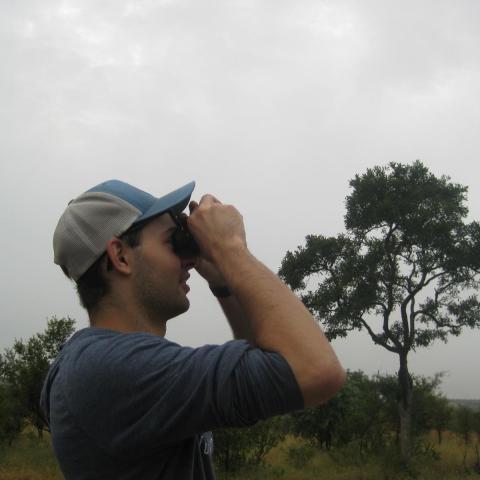
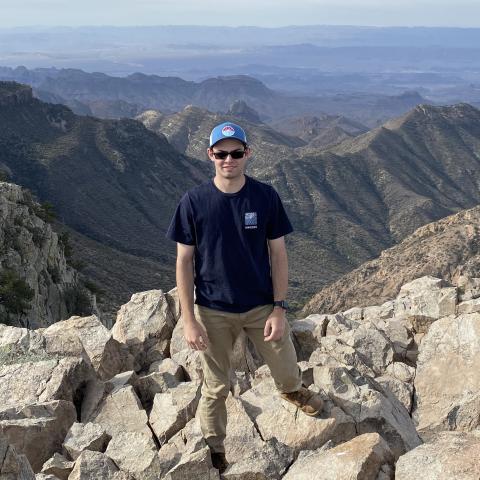
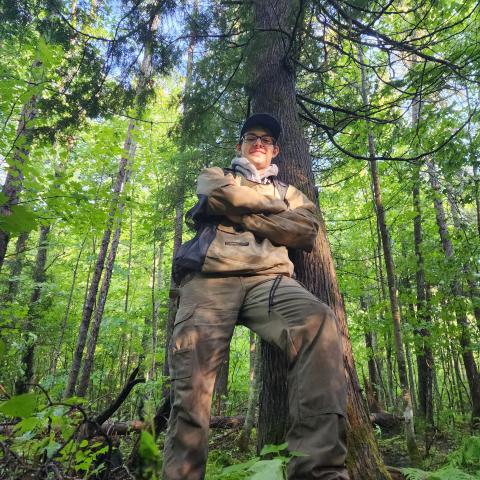
UNDERC was a game-changer, where his passion for forests deepened. “I like the questions you can ask about trees. They live longer than we do, and they are quantifiable. We can measure how light, moisture, and other variables affect them.” Asked if he has a favorite tree, his answer is instant: a red pine. One red pine at UNDERC became a personal landmark. “Whenever I saw it, I knew where I was.”
Michael’s natural tendency is to say “yes” to new experiences, and his time at UNDERC was no exception. On many mornings he rose early to assist other student researchers with their projects. “I helped a friend trap mammals, and it changed my vision of the world of small animals. It is really just another part of forest ecology. Now when I am in the woods, I notice so much more, I can ID plants and detect the slightest movement of a snake in the leaf litter.” He laughed, “And I have gotten really good at bird calls!”
Interning at UNDERC was one of the reasons Michael chose to attend Notre Dame. Another was the opportunity to study abroad. In high school, he traveled to Valencia as part of a Spanish exchange program, where he discovered his love of travel and learning about other cultures. Later, his studies at Stellenbosch University in South Africa proved transformative. “I encountered new and exciting ideas and rethought some of my own. I became aware of alternative perspectives on conservation under very different economic and political circumstances. We talk about funding cuts. They have almost no funding. Now I am more committed than ever to collaborating internationally on environmental issues.”
Michael’s time at Notre Dame balanced fieldwork with classroom study, local research with global perspective. He has come full circle, studying the forests he first loved as a child — now with scientific training and a broader lens. His academic work has increasingly incorporated remote sensing and GIS, tools that allow him to examine forest systems at larger scales. Still, collaboration and fieldwork remain at the core of whatever he does. His long-term goal is to work in a research capacity at a nonprofit, university, or government agency, leveraging remote sensing and data science to advance large-scale environmental solutions grounded in ecological understanding.
Opportunities at Notre Dame, research in the Swenson Lab, and support from mentors and the Henry David Thoreau Foundation have allowed Michael to grow as a scientist. “Compared to who I was as a freshman, today I am a confident early-career forest ecologist, with international experience across four continents and the ability to leverage interdisciplinary skills in economics and data science to tackle the world’s environmental challenges.”